

M16A4 Rifle Review: A Detailed Look at Its Role in the Marine Corps
M16A4 Rifle Review: A Detailed Look at Its Role in the Marine Corps
The M16A4, the fourth generation of the M16 rifle series, has been a reliable and crucial weapon in the Marine Corps arsenal for many years. While it has been partially phased out in favor of newer rifles like the M4, it remains a staple in many units due to its accuracy, range, and adaptability. In this detailed review, we’ll break down the specifications, performance, and operational role of the M16A4 in the Marine Corps.
📜 Historical Overview
The M16A4 was introduced in the late 1990s as an updated version of the M16A2. It features a Picatinny rail system (M5 RAS) for mounting optics and accessories, a key upgrade from its predecessors, making it a more adaptable platform for modern combat. Used extensively in Operation Iraqi Freedom (OIF) and Operation Enduring Freedom (OEF), the M16A4 became the Marine Corps’ primary service rifle for both line and support troops for much of the early 21st century.

Key Features of the M16A4
- Caliber: 5.56x45mm NATO
The standard NATO round provides a balance of range, accuracy, and stopping power, making it effective in a wide range of combat scenarios. - Operation: Direct impingement, gas-operated
This design, while effective, requires regular maintenance, especially in harsh environments like desert or jungle conditions, where dirt and debris can affect performance. - Rate of Fire: Semi-automatic and three-round burst
The M16A4 does not have a fully automatic setting, unlike some other rifles. The burst mode helps conserve ammunition while providing increased firepower in short engagements. - Barrel Length: 20 inches
The longer barrel of the M16A4 provides greater range and accuracy compared to shorter rifles like the M4. This makes it ideal for engagements in open terrain or where precision shots are needed at extended ranges. - Weight: Approximately 8.79 lbs (with a 30-round magazine)
While not the lightest rifle in the Marine Corps arsenal, its weight helps stabilize the weapon during aimed fire, increasing accuracy. - Sights and Optics: Iron sights and Picatinny rail for mounting optics
The Picatinny rail system allows Marines to equip a variety of optics, such as the ACOG (Advanced Combat Optical Gunsight), reflex sights, and even night vision systems. The ACOG has been the most common optic, providing a clear and effective reticle for both close and medium-range engagements.
Performance in Combat
Range and Accuracy
One of the standout features of the M16A4 is its effective range of up to 550 meters for point targets and 800 meters for area targets. The 20-inch barrel gives it an advantage in long-range engagements, making it particularly useful in open environments like the deserts of Iraq and Afghanistan. Marines have consistently praised the rifle for its accuracy, especially when equipped with optics like the ACOG.
Reliability
While the M16A4 is known for its accuracy, the direct impingement gas system requires regular cleaning to ensure reliability. In dusty or sandy environments, such as those encountered during OIF and OEF, it can be prone to jamming if not properly maintained. Marines are trained extensively on how to care for their weapon to minimize malfunctions, but this is a known drawback when compared to piston-driven systems.
Modularity and Adaptability
Thanks to its Picatinny rail system, the M16A4 is highly modular. Marines can attach a variety of accessories based on mission requirements, including:
- Optics: ACOG, reflex sights, night vision scopes
- Grips: Vertical foregrips for improved weapon handling
- Lights: Tactical lights for low-visibility engagements
- Lasers: Aiming lasers for precise targeting in close-quarters combat
This adaptability has made the M16A4 suitable for both urban warfare and open-field engagements.
Ergonomics and Handling
The fixed stock of the M16A4 can be a limitation in close-quarters battle (CQB) environments, where a shorter and more maneuverable weapon like the M4 would be preferable. However, for standard infantry roles, the fixed stock provides stability for accurate shooting.
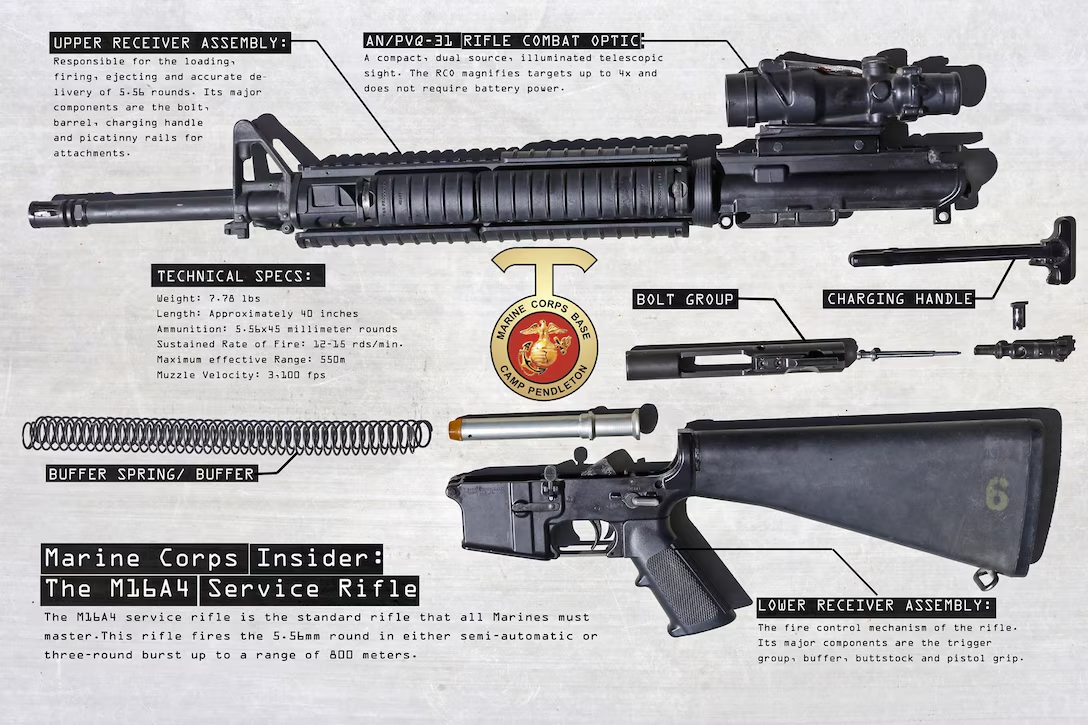
Pros and Cons of the M16A4
Pros:
- Superior Range: The longer barrel offers increased accuracy and effective range, making it ideal for long-range engagements.
- Modularity: The Picatinny rail allows for easy customization with optics and other tactical accessories.
- Accuracy: Known for precision, especially with the right optics, the M16A4 is a marksman’s weapon.
Cons:
- Weight: Heavier than more compact rifles, which can cause fatigue during long patrols or extended operations.
- Maintenance: The direct impingement system requires frequent cleaning, especially in harsh environments.
- Fixed Stock: Less ideal for close-quarters combat due to the fixed stock and overall length.

Operational Role in the Marine Corps
The M16A4 served as the primary service rifle for Marine Corps infantry units for many years, playing a critical role in both urban and rural environments. Although the M4 carbine has replaced the M16A4 in many frontline units due to its compact size and versatility in close-quarters combat, the M16A4 remains in use, particularly with support units, marksmen, and in training environments where its long-range accuracy is highly valued.
In training, the M16A4 remains an excellent platform for teaching Marines the fundamentals of marksmanship due to its precision and control.
Final Thoughts
The M16A4 is a proven weapon that has served Marines well in numerous conflicts. Its range, accuracy, and adaptability make it a reliable choice for many operational environments. However, its size and maintenance requirements have led to the adoption of more modern weapons in some units. That said, for long-range engagements and when equipped with the right accessories, the M16A4 remains a formidable weapon in the Marine Corps arsenal.

Do you have any experience with the M16A4? Let us know in the comments or share your thoughts on how this rifle has shaped your time in the Corps.
Semper Fidelis!


